
The country's real GDP growth in the first quarter will be better than the Reserve Bank's estimate of 8 per cent, economists said on Tuesday. Economists at the country's largest lender SBI pegged the growth at 8.3 per cent while domestic rating agency Icra estimated it to come even higher at 8.5 per cent. The Reserve Bank of India (RBI), which expects the GDP to grow at 6.5 per cent in FY24, has estimated a growth of 8 per cent in the April-June period.

Per capita income has more than doubled to Rs 1.97 lakh in around nine years. Indian economy has increased in size from being 10th to 5th largest in the world in the past nine years. Seven priorities of the Budget, 'Saptarishi', are inclusive development, reaching the last mile, infrastructure and investment, unleashing the potential, green growth, youth power and financial sector.

The Indian economy is projected to grow at 6.2 per cent in 2025-26, slower than earlier estimated rate of 6.5 per cent, due to escalated trade tensions and global uncertainty, the International Monetary Fund (IMF) said on Tuesday. "For India, the growth outlook is relatively more stable at 6.2 per cent in 2025, supported by private consumption, particularly in rural areas," IMF said in its World Economic Outlook (WEO).

In a continued push to spiritual tourism, there will be a focus on destinations related to the life and times of Lord Buddha.
To boost domestic manufacturing under the Make in India initiative and reduce dependency on imports, the government is expected to announce in the Budget an increase in the minimum local content requirement for public procurement, with certain sectors being granted exceptions. Currently, firms producing goods, services, or works with at least 50 per cent local content are classified as Class-I local suppliers and are preferred the most in government procurement.

The next Census' findings will help identify the extent of India's ageing population and vulnerability levels.

The central government's fiscal deficit during 2023-24 at 5.6 per cent of the GDP was better than previous estimates of 5.8 per cent on account of higher revenue realisation and lower expenditure, according to official data released on Friday. In actual terms, the fiscal deficit -- or gap between expenditure and revenue -- was Rs 16.53 lakh crore, or 5.63 per cent of the GDP, which grew 8.2 per cent in 2023-24.

At the customary post-Budget media interactions, Finance Minister Nirmala Sitharaman and her topmost bureaucrats touched upon a number of issues. The minister said the government taxing income from digital virtual assets did not give them legitimacy and that issue was being dealt separately in the planned cryptocurrency Bill. She also expressed confidence that the Budget targets were achievable.

India has allocated Rs 1.72 trillion, or 27.67 per cent of the total defence budget to cater to modernisation of the country's arsenal. Modern militaries spend up to 50 to 60 per cent of their total defence budget so that they go into combat with superior weaponry and equipment.

Forget about interim Budgets, one cannot easily recall even a full Budget of any government in recent times having rolled out benefits of this order to such a large number of people, says A K Bhattacharya.

The finance ministry will kick-start the exercise to prepare the annual Budget for 2023-24 from October 10, in the backdrop of revival of the Indian economy and fears of recession in developed countries. The budget for the next year will have to address critical issues of high inflation, job creation, boosting demand, and putting the economy on a sustained 8 per cent-plus growth path. On Wednesday, finance minister Nirmala Sitharaman said inflation is no longer "red-lettered" and the priority for the government now is job creation and boosting growth.

While demand for sub Rs 50-lakh affordable housing prevails, market players cite increased land rates, escalated construction costs and low margins as key prohibiting factors.

The sequel factor seems to have worked, as audiences have given a thumbs up to the film.

Finance Minister Nirmala Sitharaman on Thursday announced a Rs 11.11 lakh crore spending on infrastructure and vowed to continue reforms as she resisted resorting to populist measures in Modi government's last Budget before general elections, instead choosing to stay on the path of cutting deficit while bolstering measures for focus groups.

Union Finance Minister Nirmala Sitharaman, along with her team of bureaucrats, delved into the fine print of the 2024-25 Budget documents in a press conference, detailing the government's road map on bringing down the debt-to-GDP ratio and bold tax measures.

Amid FY23 Union Budget's focus on investments, leading domestic credit rating agency Crisil on Wednesday said that the capital expenditure is "not as high as it sounds". It, however, was quick to add that considering that governments usually tend to cut capex during a crisis, the government has maintained its focus on growth-spurring initiatives amid the pandemic. The research wing of the agency said, if one excludes the Rs 1 lakh crore of loans to states for capex included in the headline figure of Rs 7.50 lakh crore or 2.91 per cent, the actual spend in FY23, will go down to 2.58 per cent of GDP, which is barely at par with the revised estimate of FY22.

All eyes are now on how the film grows on Monday, as that would be crucial for the overall run of this big budget entertainer on which the industry has been pining hopes.
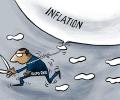
'As the Budget has taken some measures to spur growth, similar action from the MPC may be expected.'
India's economic growth slowed to near two-year low of 5.4 per cent in the July-September quarter of this fiscal due to poor performance of manufacturing and mining sectors, but the country continued to remain the fastest-growing large economy, data showed on Friday. The gross domestic product (GDP) had expanded by 8.1 per cent in the July-September quarter of 2023-24 fiscal. The previous low level of GDP growth at 4.3 per cent was recorded in the third quarter (October-December 2022) of financial year 2022-23.

Like 2017-18, govt will seek comments from the public at large, including Facebook and Twitter

The budgetary allocation for the sector is Rs 60,908.22 crore, with Rs 6,400 crore earmarked for the centre's flagship health insurance scheme Ayushman Bharat- Pradhan Mantri Jan Arogya Yojna (AB-PMJAY).

The Delhi government's budget size for 2022-23 was Rs 75,800 crore and Rs 69,000 crore in the preceding year.

Finance Minister Nirmala Sitharaman will present her sixth straight Budget ahead of the Parliamentary elections, matching the record of former Prime Minister Morarji Desai. Sitharaman in her pre-election Budget, which technically is a vote on account and popularly termed an interim Budget, will seek Parliament's nod for a grant in advance to meet the central government's essential expenditure for the first four months of the new fiscal year that starts in April. A new government elected after the April/May general elections will present the full Budget, likely in July.

...to fund the revenue gap. Of the gross market borrowing of Rs 14.13 trillion estimated for FY25, Rs 7.5 trillion, or 53 per cent, is planned to be borrowed in the first half.

Following are comments from economists at leading financial institutions, banks and rating agencies on the interim Budget:

"The new structure will substantially reduce taxes on the middle class and leave more money in their hands, boosting household consumption, savings and investment," Sitharaman said presenting what was dubbed as 'reformist' budget for the next fiscal in Lok Sabha.

Zohram Kwame Mamdani would be the city's first Muslim and Indian American mayor if elected New York mayor this November.
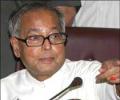
While Finance Minister Pranab Mukherjee is aiming for a return to the path of fiscal prudence, various departments of the central government appear to be out of sync.

Food budgets in urban areas spent less on protein as compared to beverages and processed foods, reveals the Household Consumption Expenditure survey data for 2023-24.

Here are the key numbers to watch out for in the Budget for 2022-23, which is widely expected to boost spending towards policies that create jobs, boost manufacturing, helping rural and agri-economy and infrastructure creation. Sitharaman, who had in her first budget in 2019 replaced leather briefcase -- which had been in use for decades for carrying budget documents -- with a traditional red cloth 'bahi-khata', has spurt in tax collections to her aid in the budget that is expected to a spend-all budget.

The outlay for defence sector almost remained unchanged compared to what was allocated in the interim budget on February 1.

On the back of robust tax collection, the ratio of direct taxes to gross domestic product (GDP) this financial year is likely to be the highest in this century so far. This, along with strong goods and services tax (GST) collection, may drive up receipts from central taxes as a proportion of GDP to the highest level or close to the highest since 2008-09 despite subdued excise and customs duty receipts. This will be due also to lower nominal GDP projected in the first advance estimates for 2023-24.

In the corresponding period of the last financial year, fiscal deficit was 39.4 per cent of the estimates.

The number of centrally sponsored schemes have increased to 35 in FY22 from 30 in FY21 and central sector schemes have increased to 704 from 685 in the previous year, reports Dilasha Seth.
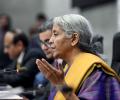
Let's wait for the monetary policy on February 8 -- to see how it complements the fiscal commitments, points out Tamal Bandyopadhyay.
The Interim Budget for 2024-25 (FY25) to be presented on February 1 is likely to assume 10-10.5 per cent nominal gross domestic product (GDP) growth against 8.9 per cent estimated for FY24 by the National Statistical Office (NSO). "We were waiting for the First Advance Estimates GDP numbers for FY24. "We will finalise the nominal GDP growth assumption for FY25 Interim Budget in a couple of days.

With 90% of the inventories sold out, JioStar expects to ring in more than a 58% increase over last year's IPL, when it clocked Rs 3,900 crore.

India's economic growth rate is estimated to slip to a four-year low of 6.4 per cent in 2024-25, mainly on account of poor showing by the manufacturing and services sector, according to government data released on Tuesday. The gross domestic product (GDP) rate of 6.4 per cent will be the lowest since the Covid year (2020-21) when the country witnessed a negative growth of 5.8 per cent.

The Centre's fiscal deficit touched 74.5 per cent of the annual target at the end of January 2025, according to the data released by Controller General of Accounts (CGA) on Friday.
